Rootedness : Women of Colour
A central part of our work in 2021 has been listening to different groups and communities talk about the idea of the public good. What it means, what they want for their communities and who is responsible. We’ve been listening to people, and we’ve also been supporting other facilitators to listen to their own communities and then come together to reflect on what we’re all hearing.
As the central coordinator of this work, Millie gets to see the group reflections and control the bigger picture story about the common themes emerging (she’s written up some of this here). This is what research does: it aggregates ideas and then spits them out in ways that are often unrecognisable to participants. It reveals common themes, strong ideas and helps the whole become more than the sum of the parts.
But, we believe the individual stories themselves are powerful, and that participants should have the opportunity to have their perspectives and language heard without being filtered by us. So we invite participants in this project to write their own blogs, and it is our great pleasure to share with you the reflections of the incredible artist Kuweni Dias Mendis.
Rootedness ~ navigating the complexity and coherence through connectivity. Building a culturally safe places as a public good.
As a woman of colour and culture my artistic activism voice is creating culturally safe spaces for people of colour. When I started my conversations with Australia reMADE as a part of their New Public Squares Project I shared my interests to hold space for women of colour and find out what was important to them. As the conversations progressed I felt I was heard, acknowledged and my voice mattered.
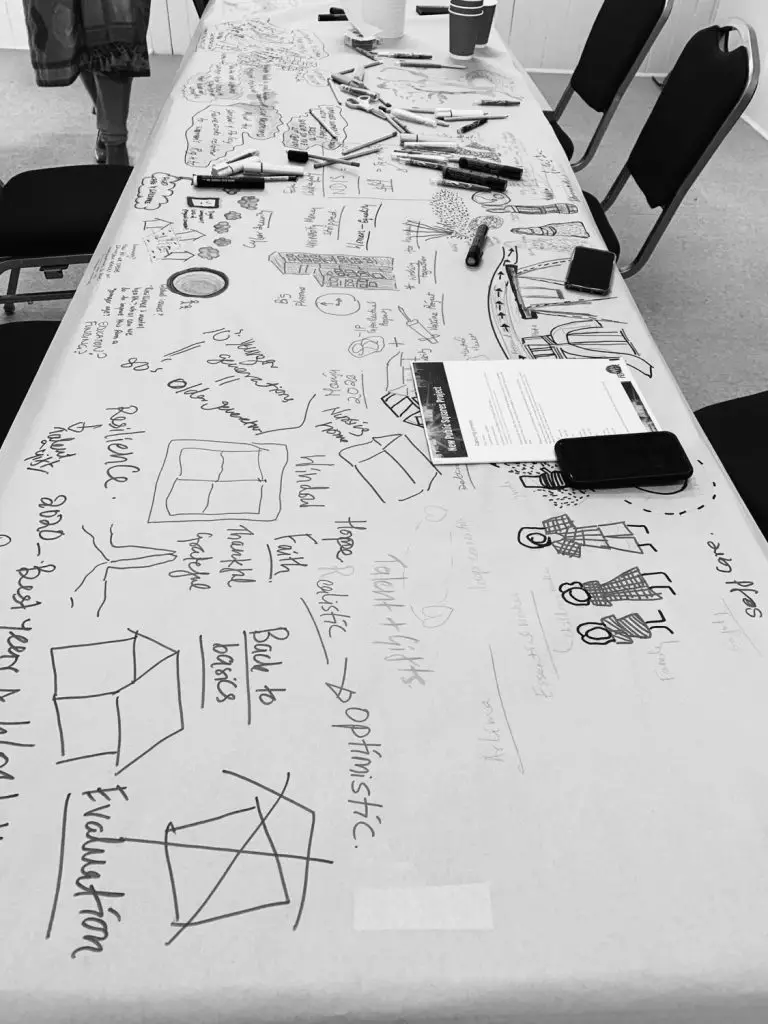
I held conversations by creating a space for women of colour to talk and to create art as a way to make the best outcomes of the time together for all involved. These sessions were carefully curated so the women were able to express themselves creatively through imagery around themes that sometimes had no language.
I reached out to a group of women from varied professional backgrounds to be a part of the public squares program. When we got together most of us didn’t know what we were going to unearth. I was there to listen and ask questions, and they were there to talk and doodle as they listened to the group. These women were utterly courageous to turn up the first day and the next few sessions as the conversations progressed. After our sessions we shared a common meal together and continued to keep in touch through a chat called “Women for Women”.
The first conversation
In our first conversations we unearthed the need to belong without needing to fit in. To me fitting in is when we have to squeeze ourselves into a mould that’s already made for us by the dominant culture, then there’s fear of being left out hence we pretend to be somebody else. Belonging is when we can take our whole self, the magnitude of who we are to spaces, knowing we are accepted and we matter when it’s safe to be ourselves without compromising.
And we talked about the need for inclusion. Inclusion in public spaces, workspaces, universities and any organisation with cultural safety. We want spaces where people and programmes see and accept people of colour as we are without needing to culturally fit in for the dominant culture. Where different types of intelligence and experience of different backgrounds are accepted equally without being dismissive.
We acknowledged the need for a physical Space for Women to gather as women of colour and culture for talking and healing, connecting and sharing, building capacity with women of different age groups, different life cycles and different experiences to support each other.
In these doodles from the first conversation the fully formed trees that were rooted spoke to me, the pathways that emerge in our journeys, river of life, the Sun that meant energy, source of life and hope stayed with me.
The second conversation
The second conversation we identified the importance of acknowledging the history and culture that exist within Australia; acknowledging the rich culture and history we bring to the land and also allowing space for these two to blend in and focusing on the shared values, and allowing something new to merge that did not exist before.
We saw two main parts to work on:
Changing the mainstream narrative.
Creating a space exclusively for Women of Colour, where there was cultural safety.
The second conversation was intense and intimate that most of us didn’t doodle much.
Again I noticed the trees and the rootedness they represent, the struggles that were real, the need to evolve and the words “egoless state”, “we are all refugees” and “we lift ourselves by lifting others” struck me hard.
The third conversation
The third conversation was about determining our mission and vision. We determined as a group that our big vision is EDUCATION – it’s educating the dominant culture of our struggles and cross-pollination in wider groups to educate people. We also need to educate ourselves in the areas of emotional wellbeing, attitude, communication style, creative expression, empowerment etc.
We determined as a cohort that we would like to have four sub categories under this banner such as Inclusivity, Freedom of Expression, having Fun and Resilience. So the mission is to “remain coherent within complexity through connectivity”.
These last doodles were about connectivity, convergence and coherence.
My creative process
I am a multidisciplinary artist influenced by ritual drawing practices of my country of birth, Sri Lanka.
I have four phases in my arts practice that align with the four phases of the moon cycle. In these cycles I deeply listen, deeply think and deeply learn. In the new moon cycle I go out in nature where I gather materials to make my own brushes, inks, pigments and natural dyes and make drawings of the things I see in the landscape. Then in the waxing moon I do an installation of the things I gather and make a collage with the drawings then in the studio then in full moon I think about what’s surfaced and I find the essence of the work this is thinking beyond the shapes and forms that’s come to me but also the intelligence that’s come through humans and non humans through synchronicity the patterns and the themes that’s merged and make bigger works in studio with guache, inks, watercolours and pastels that’s commercially produced and toward the waning phase I translate the work to fibre work with dyeing and stitch and learn new knowledge from where I have merged.
In making this piece of art I stretched my practice to interpret marks made by humans rather than the marks I see in nature.
To me the doodling was a representation of the diversity of thoughts and my role was to bring it to a convergent whole making sure the integrity, intimacy and trust built within the diversity was not lost. What unveiled was the feeling of “Rootedness” supported by a network of fungi and the nuances were what needed to be portrayed.
I studied our doodles and a stream of consciousness merged for me. I put some of these doodles into a sequence that made sense to me on a piece of paper and let my body listen to it over a few days. I later drew shapes and forms then dissembled it into pieces.
It was also important that I was still true to my ritual art process and it was expressed in my inherent visual language. Here I painted the surface with lichen ink. Lichens thrive in very hostile environments, including “arctic tundra, hot dry deserts, rocky coasts, and toxic slag heaps. They can even live inside solid rock, growing between the grains. Some lichens do not grow on anything, living out their lives blowing about the environment” (Wikipedia). This represents the resilience and resourcefulness that’s inherent in women of colour. The pink hues represent the blood that flows underneath the skin that’s universal to humans. I then used the same medium the women doodled with which were markers in shades of brown to convey our unique story.
The roots and the fungi for rootedness, the boat that represent migration, other forms that speaks for non linearity, interconnectedness, hope and evolution of consciousness around cultural safety. The Winds, the Fungi and the Trees are part of the Old Landscape. This ancient land and for its original people these elements are also their ancestors. I want to pose the question, “Did we actually initiate our migration to Australia or did we respond to Australia’s calling?”
Rootedness ~ the complexity and coherence through connectivity.